
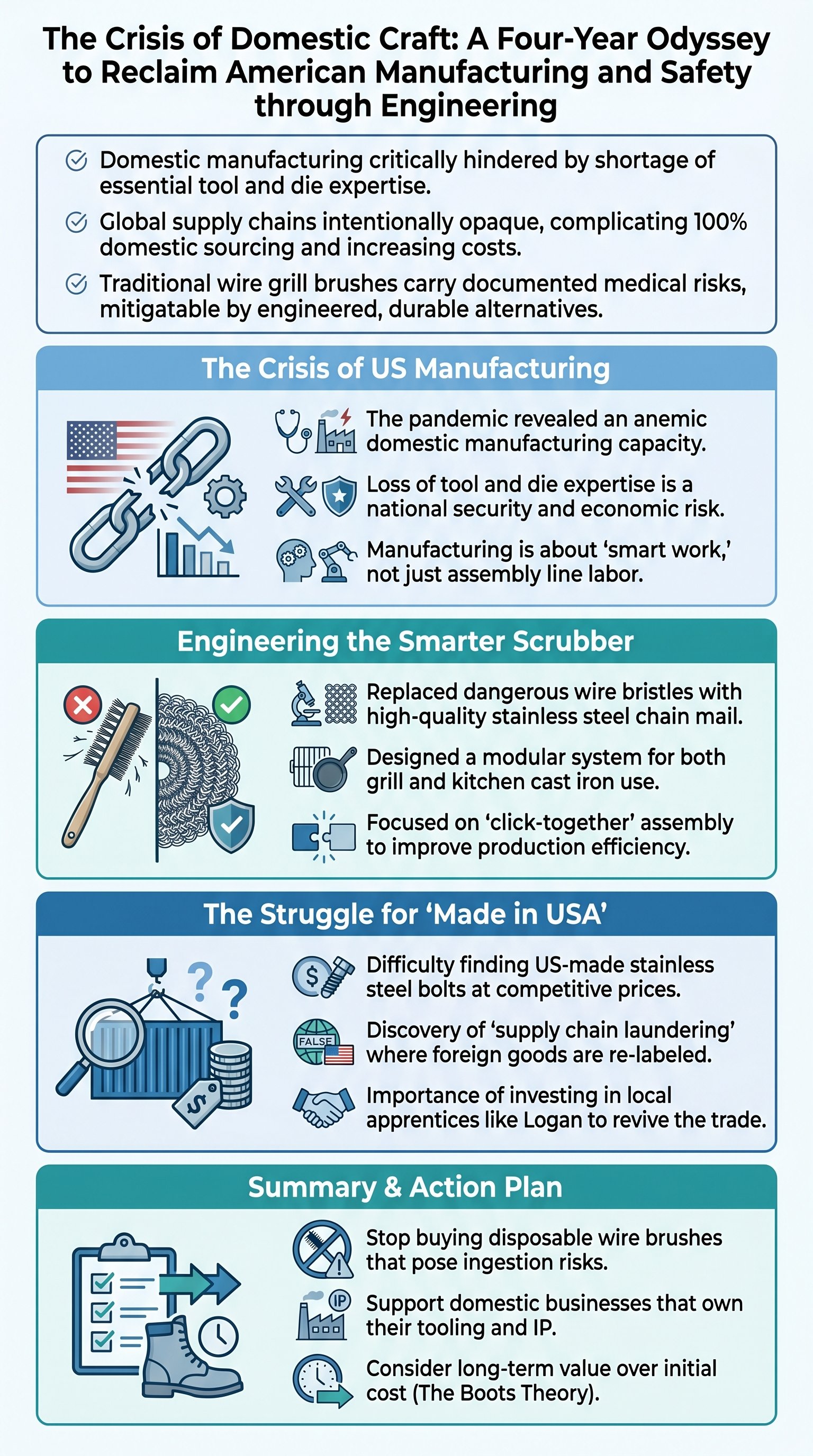
The Erosion of the American Industrial Foundation

The journey of the Smarter Scrubber began not just as a product idea, but as a response to a systemic failure in domestic manufacturing. For decades, global economic shifts have pushed production overseas, prioritizing immediate profit over local industrial stability. This experiment highlights how the pandemic served as a wake-up call, revealing that the United States has lost much of its capacity to produce essential items independently. When local communities lose their factories, they lose more than just jobs; they lose the self-reliance and the collective knowledge required to innovate and respond to crises.
Historically, the middle class was built on the back of people who made physical things. The shift toward containerized shipping and global trade agreements changed the calculus, making it cheaper to exploit labor in developing nations than to maintain domestic facilities. This has led to a 'gutted' manufacturing landscape where the knowledge chain is nearly broken. To rebuild this, we must recognize that manufacturing is not just about pushing buttons on a machine; it is about the intellectual property and the specialized skills required to design and maintain the tools of production.
Key insight: Local manufacturing is the ultimate guarantor of a community's stability, freedom, and ability to survive global supply chain disruptions.
Developing a domestic product today requires fighting against every established market force. The experiment proves that while 'Golden Age' thinking is often nostalgic, the reality of modern logistics makes returning to local production an uphill battle. However, the goal of this project was to prove that through engineering and intentionality, it is still possible to create a superior product that supports local economies.
The Intellectual Property Trap and the Amazon Dilemma

A significant barrier for small business owners like John Youngblood of JJGeorge is the rampant piracy facilitated by global e-commerce platforms. When a product is manufactured overseas, the tooling is often used by third parties to create lower-quality knock-offs that are then sold directly against the original creator. This creates a 'whack-a-mole' scenario where legal recourse is expensive and often futile. Amazon’s data-driven environment even signals to these pirates which products are high-volume, essentially painting a target on successful domestic designs.
- Product pirates often use lower-grade materials to undercut prices.
- Original designers lose their tooling control when manufacturing is outsourced.
- Legal fees to protect patents can bankrupt small domestic startups.
- Platforms like Amazon often prioritize sales volume over the protection of intellectual property.
Caution: Outsourcing production doesn't just lower costs; it often exports your competitive advantage to entities that have no legal obligation to protect your brand.
This lack of policing in the global marketplace destroys the incentive for American manufacturers to innovate. By keeping the Smarter Scrubber project local and avoiding traditional mass-market platforms, the creators aim to maintain control over their quality and brand integrity. This strategy requires a unique marketing approach, such as leveraging a YouTube audience, but it serves as a blueprint for how others might bypass the 'piracy trap' by building direct community relationships.
The Technical Struggle of Sourcing and Molding
The engineering phase of the Smarter Scrubber revealed the shocking difficulty of sourcing even basic industrial commodities like stainless steel bolts and chain mail from domestic sources. While foreign-made bolts cost pennies, American-made equivalents can be four times more expensive due to material and labor costs. The search for a US supplier led to a complex web of verification, where even reputable distributors were sometimes mistaken about the origin of their stock.