Nature's Hidden Algorithm: The Mystery of Self-Similar Branching
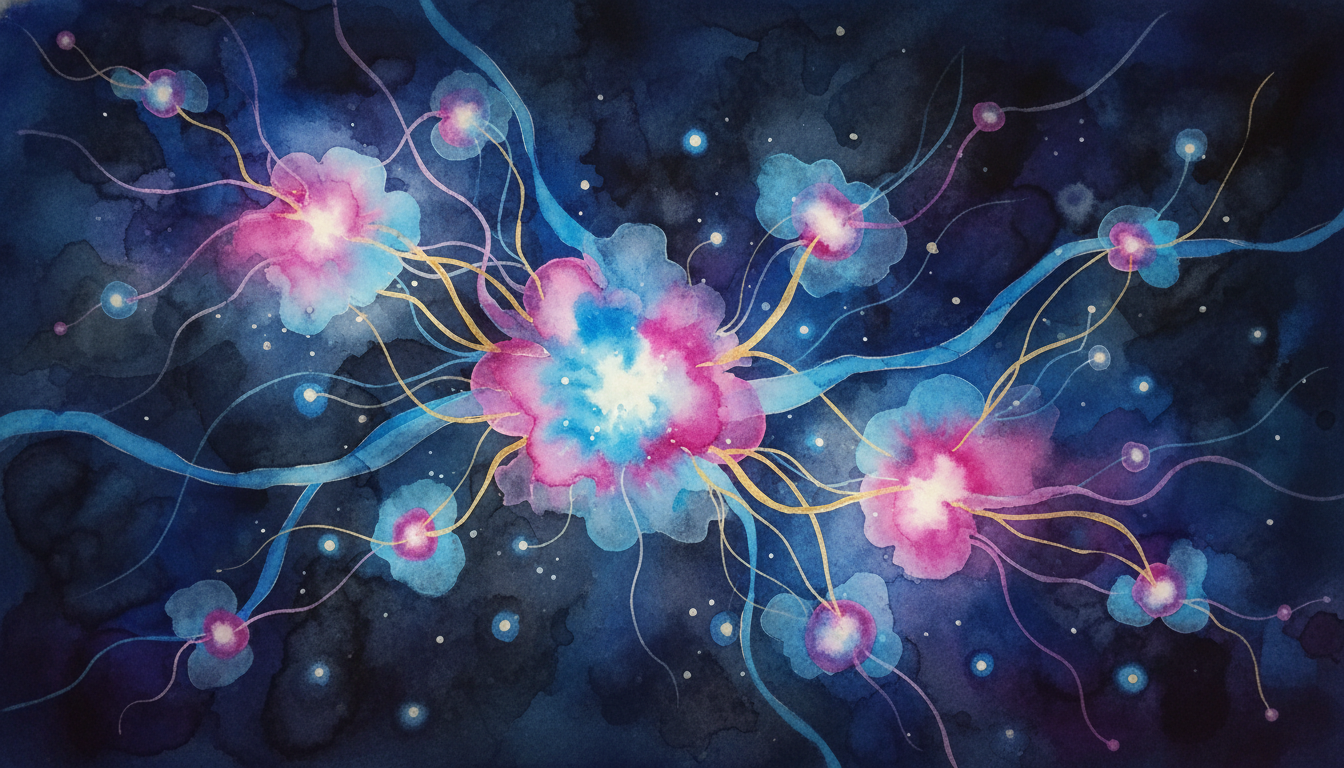
When we observe the world closely, we begin to notice a recurring motif that transcends the boundaries between the living and the inanimate. A single branch of a tree often looks remarkably like a miniature version of the entire tree. This phenomenon, known as self-similarity, is not a mere coincidence but a fundamental architectural principle of our universe. From the deep subterranean networks of roots to the sprawling deltas of great rivers, the same branching logic applies. This structural consistency suggests that nature has found a 'perfect' way to organize complexity, using a simple set of rules that repeat infinitely.
These patterns are called fractals, a term coined by the mathematician Benoit Mandelbrot. Unlike the smooth shapes of Euclidean geometry—circles, squares, and triangles—fractals are jagged, irregular, and infinitely detailed. If you zoom in on a fractal, you do not find a simpler shape; instead, you find the same level of complexity repeated over and over. This 'infinite recursion' allows nature to pack an incredible amount of information and functionality into a very small footprint. It is the secret language through which the natural world communicates its need for efficiency.
In our daily lives, we are surrounded by these structures, though we often fail to recognize them. The veins in a leaf, the cracks in a drying mud flat, and the electrical discharge of a lightning bolt all follow this branching logic. This is not because they share a common ancestor or a specific genetic code, but because they all face the same physical challenges. Whether it is a tree seeking sunlight or lightning seeking the path of least resistance to the ground, the fractal branch is the most effective way to explore and fill a given space.
| Feature | Euclidean Geometry | Fractal Geometry |
|---|---|---|
| Shape | Smooth, ideal (circles, squares) | Rough, irregular (clouds, trees) |
| Scale | Changes appearance when zoomed | Remains self-similar at all scales |
| Dimensions | Whole numbers (1, 2, 3) | Fractional numbers (1.58, 2.7, etc.) |
| Origin | Human-made abstraction | Found everywhere in nature |
Rethinking Dimensions: The Mathematics of the In-Between
To truly understand fractals, we must abandon our traditional understanding of dimensions. We are taught that a line is one-dimensional, a square is two-dimensional, and a cube is three-dimensional. However, Benoit Mandelbrot proposed that many objects exist in fractional dimensions. This sounds like science fiction, but it is a concrete mathematical reality. A fractal curve, for instance, is more than a one-dimensional line because it twists and turns to fill space, yet it is less than a two-dimensional plane because it never fully covers a surface.
Consider the scaling laws of standard shapes. If you double the length of a line, its length increases by a factor of 2 (2 to the power of 1). If you double the sides of a square, its area increases by a factor of 4 (2 to the power of 2). If you double the edges of a cube, its volume increases by 8 (2 to the power of 3). These exponents—1, 2, and 3—are the dimensions. However, when you scale a fractal like the Sierpinski triangle, doubling its size might result in a length that is exactly 3 times longer. The exponent required for this (2 to the power of X = 3) is approximately 1.58. This is the Hausdorff dimension, and it defines how a shape fills space.
ここからが大事な
ポイントです
具体例・注意点・明日から使えるヒントを整理しています。
✨無料閲覧で全文 + 図解の完全版を3日間いつでも読み返せる
あなたの好きな動画も、
1〜2分でAI要約
📚 お気に入り保存 + ✨ あなたの動画をAI要約
(無料登録10秒)
✏️ この記事で学べること
- ▸「」
10秒で完了・パスワード作成不要