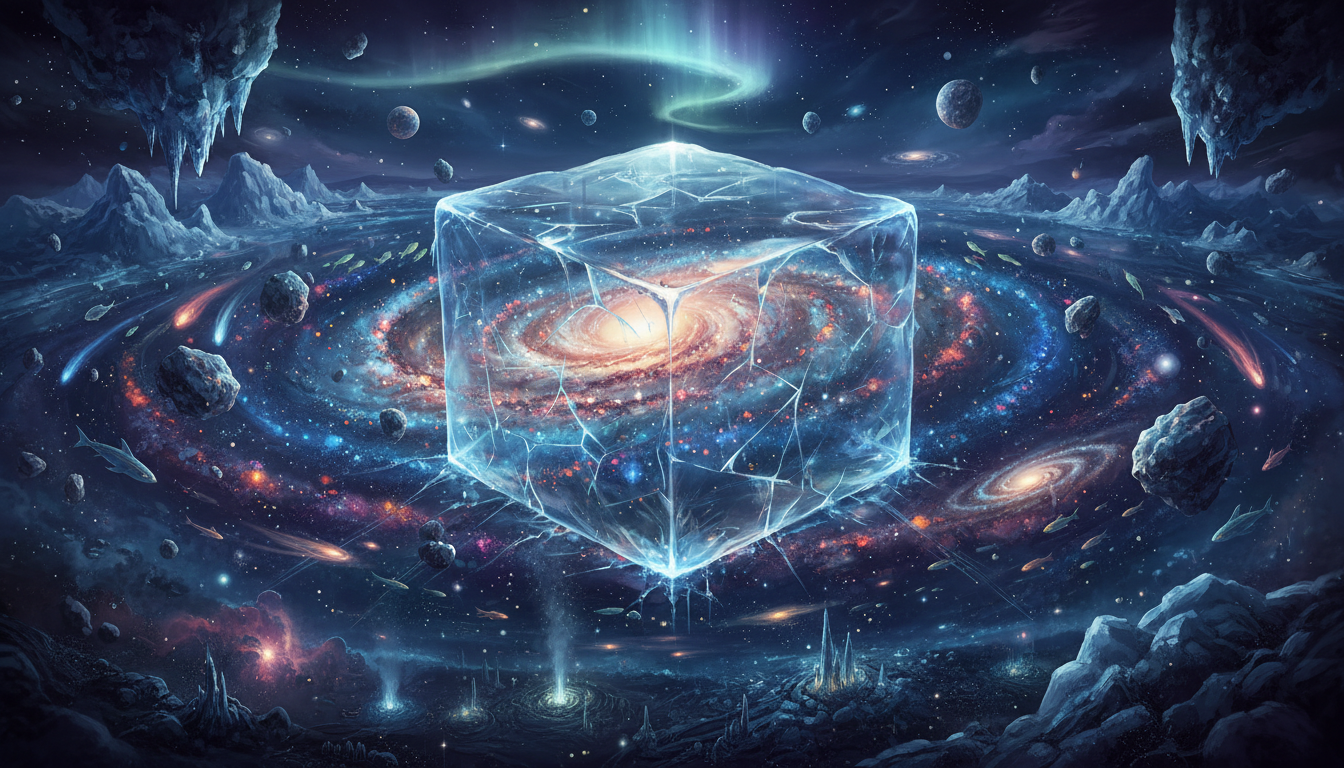
The universe is not primarily composed of the glittering stars and galaxies we see in photographs. Instead, the vast majority of the cosmos consists of unfathomable stretches of nothingness known as cosmic voids. These are gigantic bubbles of darkness, stretching hundreds of millions of light-years across, where matter is so sparse it is almost non-existent. Despite their emptiness, these voids are active participants in the evolution of the universe, growing and merging to shape the large-scale structure of everything we know. As we move away from our local neighborhood, including the Milky Way and Andromeda, we encounter the Virgo Supercluster. Beyond these dense structures lie the true giants: the Local Void and the terrifyingly vast Boötes Void. The Boötes Void is a cosmic desert 300 million light-years wide. If you were placed in its center, the sky would be completely black, offering no indication that an outside universe even exists. It is, for all intents and purposes, the loneliest place in existence. Inside these voids, the laws of gravity create a strange environment. Because there is almost no mass within a void, the dense galaxy clusters and filaments surrounding it exert a stronger gravitational pull. This creates a 'tug-of-war' effect where matter is constantly being sucked out of the void’s interior and onto its edges. This phenomenon explains why galaxies appear to sit on the rims of these bubbles, much like reflections on soap bubbles, and why it is naturally difficult for a galaxy to enter a void. However, voids are not entirely empty. They contain faint filaments of dark matter and rare 'Void galaxies'. These isolated systems are like lonely fireflies in a dark ocean. Because they are so far from the gravitational disruptions of other galaxies, they evolve in slow motion. They tend to be smaller, bluer, and full of gas, birthing stars at a much calmer pace than their counterparts in crowded clusters. Some scientists speculate that these quiet refuges might be the last habitable places in the dying stages of the universe. The most significant characteristic of voids is their relationship with dark energy. While gravity dominates in dense regions, dark energy's effects are most visible within the emptiness of voids. Here, the force accelerating the expansion of the universe 'blows up' these bubbles of nothingness. As voids expand, they thin out the walls of the cosmic web, eventually ripping apart the beautiful filaments of galaxies that have existed for billions of years. Looking into the far future, the expansion of voids represents the ultimate fate of the cosmos. As supervoids merge and grow, they will eventually consume the observable universe. The dense clusters of galaxies we see today will be crushed and isolated, and the universe will transition into a singular, eternal void of nothingness. Understanding these terrifying spaces is therefore essential to understanding how the universe began and, more importantly, how it will inevitably end.
The Architecture of Nothingness: Understanding Cosmic Voids and the Final Fate of Our Universe
結論Cosmic voids are massive, expanding regions of emptiness that dictate the universe's structure. Driven by dark energy, they will eventually dissolve the cosmic web into total nothingness.

Kurzgesagt – In a Nutshell/This Is the Scariest Place in The Universe/📅 2026年3月10日 公開
信じられますか?このクオリティの記事と図解を manabi は たった1分 で自動生成しました
この動画の重要ポイント
- 1Cosmic voids are not mere empty spaces but dynamic, growing structures that constitute the vast majority of the universe's volume.
- 2The 'push' effect of voids is actually caused by the gravity of surrounding galaxy clusters pulling matter away from low-density regions.
- 3Dark energy's influence is most visible within voids, where it drives the accelerated expansion that will eventually dissolve the cosmic web.
こんな人におすすめ
- Astronomy enthusiasts
- Science students
- Conceptual thinkers
manabi 編集部の視点
This video provides a profound look at the large-scale structure of the universe, shifting the focus from visible matter to the 'nothingness' that defines it. A practical caveat for readers is that while these voids are described as 'empty,' they are never truly a perfect vacuum, as they contain dark matter and incredibly low-density gas that remain difficult to detect. The interpretation of voids as 'last refuges' is a compelling perspective on the Heat Death of the universe. For those interested in the 'Big Rip' or 'Big Freeze' scenarios, cosmic voids provide the most direct evidence of the
AIが生成したビジュアル
タップして拡大

あなたが見たい動画も
1分で要約・図解化しませんか?
無料登録で累計3回まで
主要トピック
The Reality of Empty Space
- Voids are bubbles of darkness hundreds of millions of light-years wide.
- They constitute the majority of the universe's volume.
- The Boötes Void is so large it should contain thousands of galaxies, but is nearly empty.
Gravity and the 'Push' Effect
- Voids don't technically 'push' matter; matter is 'pulled' out by exterior gravity.
- Galaxies remain stuck to the 'rims' of voids like soap bubble reflections.
- Entering a void is difficult because gravity pulls you back toward the dense edges.
Void Galaxies: The Last Refuges
- Void galaxies are isolated, gas-rich, and age in 'slow motion'.
- They may be the final habitable places in a dying universe.
- Dark energy is most observable in these empty regions, driving cosmic expansion.
Summary & Action Plan
- Understand that the universe's structure is defined by its gaps, not just its matter.
- Recognize the role of dark energy in the inevitable dissolution of the cosmic web.
次はあなたが魔法を使う番です
あなたが作った要約が、
同じように悩む誰かの灯火になります。
無料登録で累計3回まで
よくある質問
Q1.What exactly is inside a cosmic void?
While mostly empty, voids contain faint filaments of dark matter and rare 'void galaxies.' They are also the regions where dark energy is most dominant, driving the expansion of space itself.
Q2.Why don't galaxies just float into the voids?
Gravity from the dense galaxy clusters on the edges of the voids pulls everything outward. It acts like a tug-of-war where one side isn't pulling, making it naturally difficult for matter to settle inside a void.
Q3.Is the Boötes Void the largest one?
It is one of the most famous and largest 'supervoids,' but astronomers continue to discover more. It is significant because of its extreme lack of galaxies despite its massive size.
Q4.Will our galaxy eventually be swallowed by a void?
In the very distant future, the expansion of voids driven by dark energy will thin out the filaments our galaxy belongs to, eventually isolating us in an ever-growing expanse of emptiness.
Q5.Can we see voids from Earth with a telescope?
You cannot 'see' a void directly because it is an absence of light. However, astronomers map them by observing the distribution of surrounding galaxies and the way light bends around them.