The End of Reality as We Know It: The Fall of Local Realism
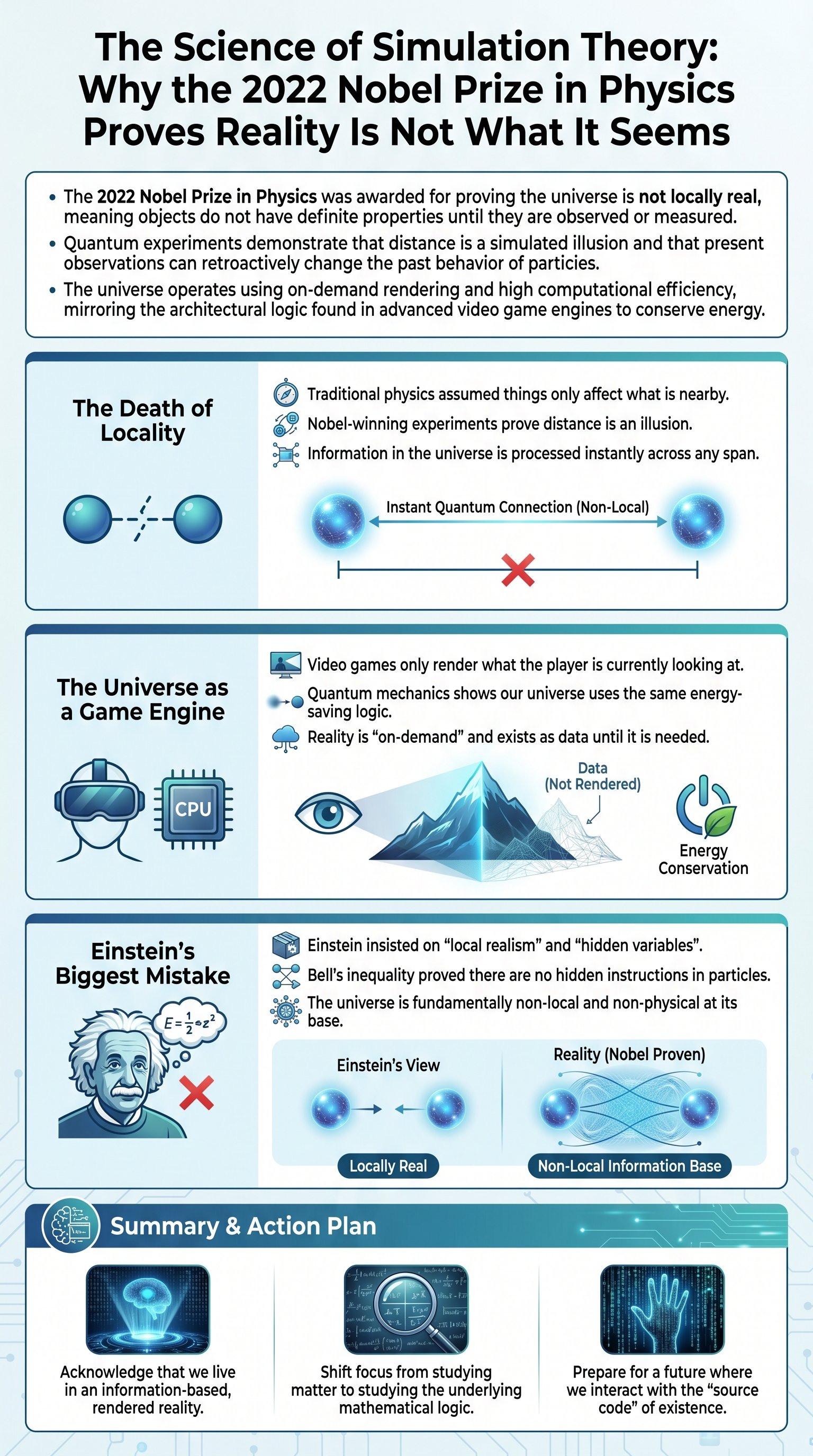
For centuries, human understanding of the world rested on two bedrock assumptions: locality and realism. Locality is the common-sense idea that objects can only be influenced by their immediate physical surroundings. Realism is the belief that objects possess definite, objective states regardless of whether anyone is looking at them. We assume the moon exists in a specific spot even when we sleep. However, the 2022 Nobel Prize in Physics, awarded to Alain Aspect, John Clauser, and Anton Zeilinger, effectively demolished these concepts. Their work proved that the universe is not locally real. This means that the physical world we inhabit does not actually 'exist' in a concrete state until it is interacted with by a measurement or observation.
This discovery validates what many physicists have long suspected: our reality functions more like a computational output than a permanent physical construct. When we look at a coffee cup, we assume its position and temperature are fixed. In reality, at the quantum level, that cup exists only as a probability set until the system—the universe—is forced to resolve that data into a specific state. This is not a philosophical metaphor; it is a hard scientific fact backed by the most rigorous experiments in human history. We are essentially living in a reality that renders itself on the fly, optimizing its resources just as a software developer would when building a massive open-world game.
Key insight: The universe does not waste energy rendering what is not being observed. It maintains a state of mathematical potential until the moment information is required by the system.
| Concept | Classical Realism | Quantum Reality (Simulation) |
|---|---|---|
| State of Objects | Permanently fixed and objective | Probabilistic until observed |
| Influence | Limited by physical distance | Instantaneous regardless of distance |
| History | Linear and unchangeable | Retroactively determined by the present |
The Ghostly Mechanics of Observation and Wave-Particle Duality
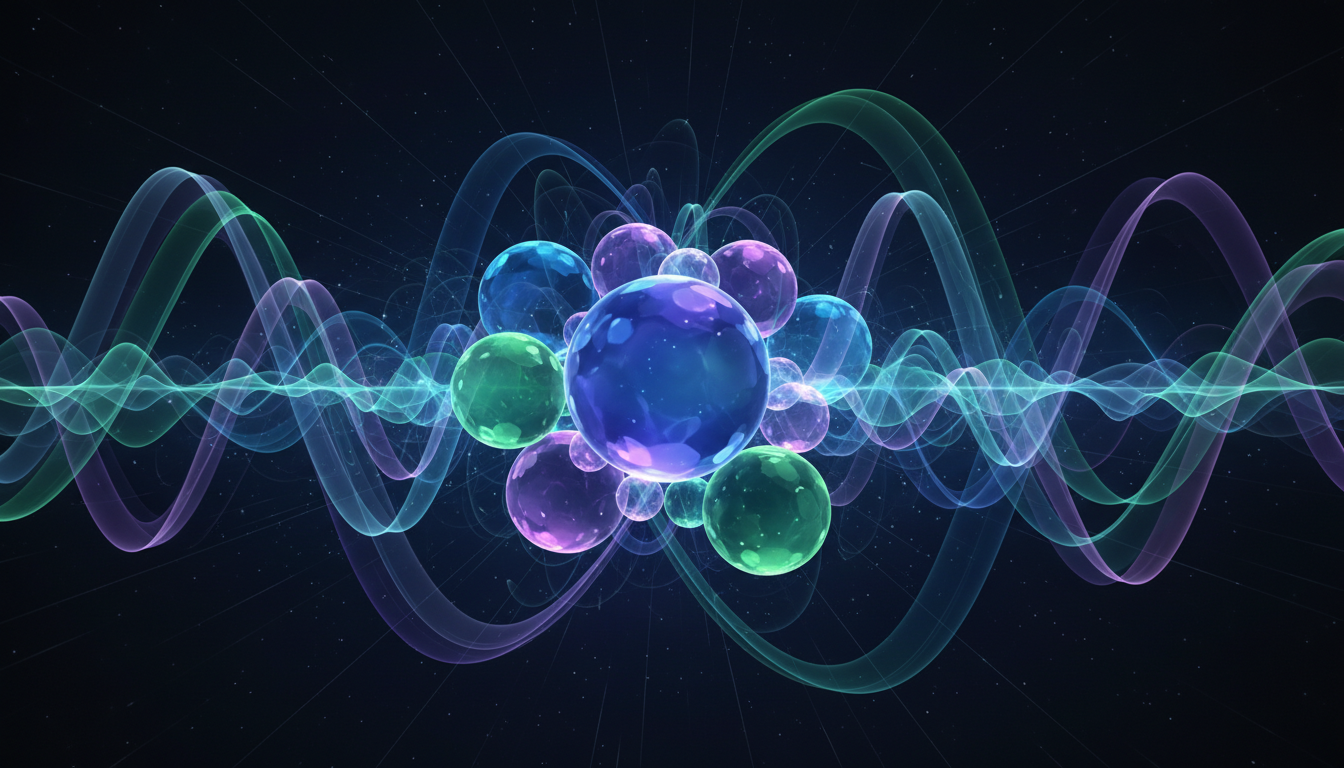
The foundation of this mind-bending reality lies in the double-slit experiment. When scientists fire photons or electrons at two slits, the particles behave like waves, creating an interference pattern (often called zebra stripes). This suggests that a single particle can pass through both slits simultaneously, interfering with itself. This state is known as superposition. However, the moment a detector is placed to see which slit the particle 'actually' goes through, the wave behavior vanishes. The particle suddenly acts like a solid piece of matter, hitting the screen in two clean bands. The mere act of capturing information forces the universe to collapse the wave of probability into a single, rendered point of reality.
This behavior is identical to how a game engine like Unreal Engine or Unity functions. To save processing power, a game does not fully render the entire map at once. It only calculates and displays what is within the player's field of view. The rest of the world exists only as code and data—potentialities waiting to be visualized. Einstein famously hated this idea, calling it 'spooky action at a distance.' He spent the final 30 years of his life trying to find 'hidden variables' that would prove the universe is real and independent of us. He failed because the hidden variables simply do not exist. The universe is fundamentally information-based, not matter-based.
The universe responds to information processing, not just human consciousness. Any interaction that records data about a particle's path—even a stray photon hitting a detector—causes the reality to 'lock in.' This suggests that the 'base layer' of our existence is not atoms, but binary logic and mathematical computation.
- 1Particles exist as waves of probability (Superposition).
- 2Observation or interaction captures information.
- 3The wave function collapses into a definite particle state.
- 4The universe 'renders' the result to maintain consistency.
Temporal Paradoxes: Why the Present Rewrites the Past
Perhaps the most shocking evidence comes from the delayed-choice experiment proposed by John Archibald Wheeler. In this setup, researchers decide whether or not to observe a particle *after* it has already passed through the slits. Logic dictates that the particle's path is already history. But the results show otherwise: if we choose to observe it after the fact, the particle retroactively behaves as if it had been a particle all along. If we choose not to, it retroactively acts as a wave. This means the present moment has the power to reach back in time and rewrite the history of the universe to ensure the current state is mathematically consistent.