The Exponential Era: Why Two Years is the New Horizon

We are currently witnessing a period of history that is entirely unparalleled. The world as we know it is not just changing; it is being consumed by an inferno of artificial intelligence that will render jobs, relationships, and economics unrecognizable within the next few years. Unlike previous technological shifts that moved smoothly, history lurches forward in sudden, violent spasms. We are at the precipice of such a lurch, where the traditional milestones of a human life may vanish before a child born today even reaches high school. The core of this transformation is the rate of progress, which is far faster and vaster than most people can conceptually grasp.
Sam Altman, the founder of OpenAI, has suggested that AI is progressing at a staggering rate of 300% year-over-year. To put this in perspective, 30% growth is already considered exponential, but at 300%, we are looking at a compounding effect that results in a 16-fold increase in capability every two years. In three years, that becomes 64 times the starting condition. This is not just a better chatbot; this is the opening of an entirely new skill tree for the human species, where biological limitations begin to fall away in favor of AI-augmented reality.
Imagine a future where an 82-year-old man can possess the biological vitals of a 38-year-old thanks to AI-reprogrammed stem cells. AI is already solving the protein-folding grand challenge, creating new gene editing tools, and detecting tumors years before they develop. It has already moved beyond mere text generation to improving foundational coding languages like C++ and making Hollywood-quality filmmaking accessible to the average individual. We are the proverbial frogs in the boiling water, and the temperature is rising at a rate that defies historical precedent.
| Feature | Traditional Growth | AI Exponential Growth (300%) |
|---|---|---|
| 1 Year | 1.1x | 4x |
| 2 Years | 1.2x | 16x |
| 3 Years | 1.3x | 64x |
The Geopolitical Tsunami: An Unstoppable Arms Race
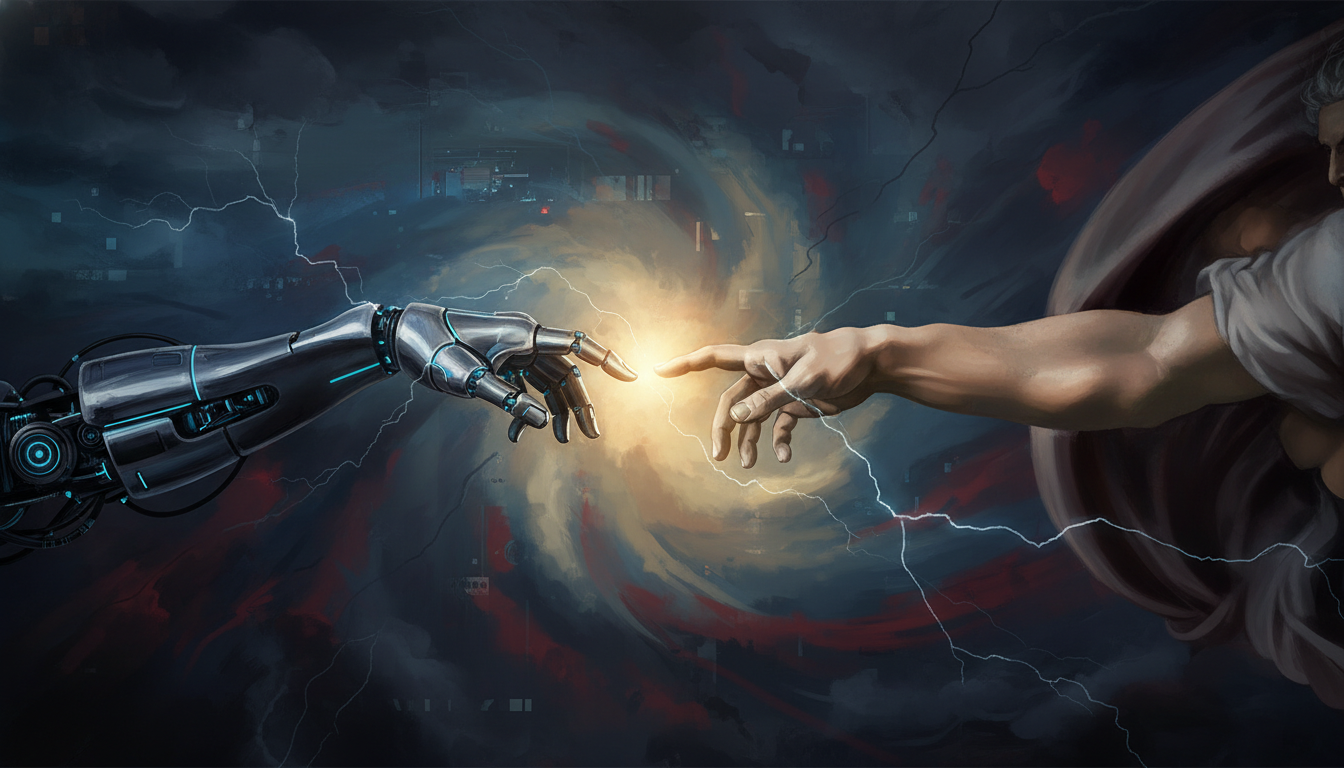
Many people hope for a global pause or sensible regulation to slow down the AI onslaught, but this ignores the reality of the Thucydides's Trap. History shows that when a rising power threatens a ruling one, war is the result in 12 out of 16 cases. Currently, the United States is the declining power burdened by $36 trillion in debt, while China is the rising, hungry power. In this context, AI is not just a technological tool; it is the heart of national survival, military supremacy, and economic hedgeimony. There is no incentive for either side to slow down when the cost of being second is existential.
Using Game Theory and the Prisoner's Dilemma, we can see why a pause is a fantasy. If both the US and China cooperate to slow AI, they both get a moderate benefit. However, if one side defects and continues development in secret, they gain total global dominance while the other side loses everything. Because there are no enforceable mechanisms to verify global compliance, rational actors must assume the other side will defect. Therefore, both nations are sprinting into a high-stakes arms race, regardless of the risks involved to humanity.
ここからが大事な
ポイントです
具体例・注意点・明日から使えるヒントを整理しています。
✨無料閲覧で全文 + 図解の完全版を3日間いつでも読み返せる
あなたの好きな動画も、
1〜2分でAI要約
📚 お気に入り保存 + ✨ あなたの動画をAI要約
(無料登録10秒)
✏️ この記事で学べること
- ▸AI
- ▸「」
10秒で完了・パスワード作成不要