The Psychological Gap Between Textbook Diagrams and Physical Reality

Most people grow up with a mental model of the Earth-Moon system that resembles a 'slinky' or a series of tight loops moving through space. We are taught that the Moon orbits the Earth, and since the Earth orbits the Sun, the Moon must naturally follow a spiraling or 'wiggly' path. This visualization is fundamentally flawed because it fails to account for the massive scale and relative velocities involved in our solar system. In truth, the Moon's motion is far more dominated by the Sun than most non-physicists realize.
From the perspective of an observer far above the ecliptic plane, the Moon's path never actually curves outward away from the Sun. It remains perpetually convex, meaning it is always curving inward toward the solar center. This realization challenges the very definition of what it means to be a satellite. If the Moon is always falling toward the Sun, why do we consider it an appendage of the Earth? The answer lies in the subtle nuances of gravitational dominance and orbital speeds.
To understand this, we must first look at the geometry of the orbit itself. The Moon travels around the Sun at approximately 30 kilometers per second, while its orbital speed relative to the Earth is only about 1 kilometer per second. Because the Sun's orbital velocity is so high, the Moon's small 'deviations' caused by the Earth are not enough to create a loop. Instead, they merely result in a slight flattening or sharpening of a circular path, resulting in a shape that resembles a 12-sided polygon with rounded corners.
This phenomenon is not just a visual curiosity; it reflects the underlying hierarchy of forces. In the vastness of space, scale is everything. When we zoom out far enough, the Earth and Moon appear to be two objects traveling side-by-side in nearly identical orbits, occasionally nudging each other but both fundamentally tethered to the Sun's massive gravitational well.
The Geometry of Epitrochoids and the Spectrum of Motion
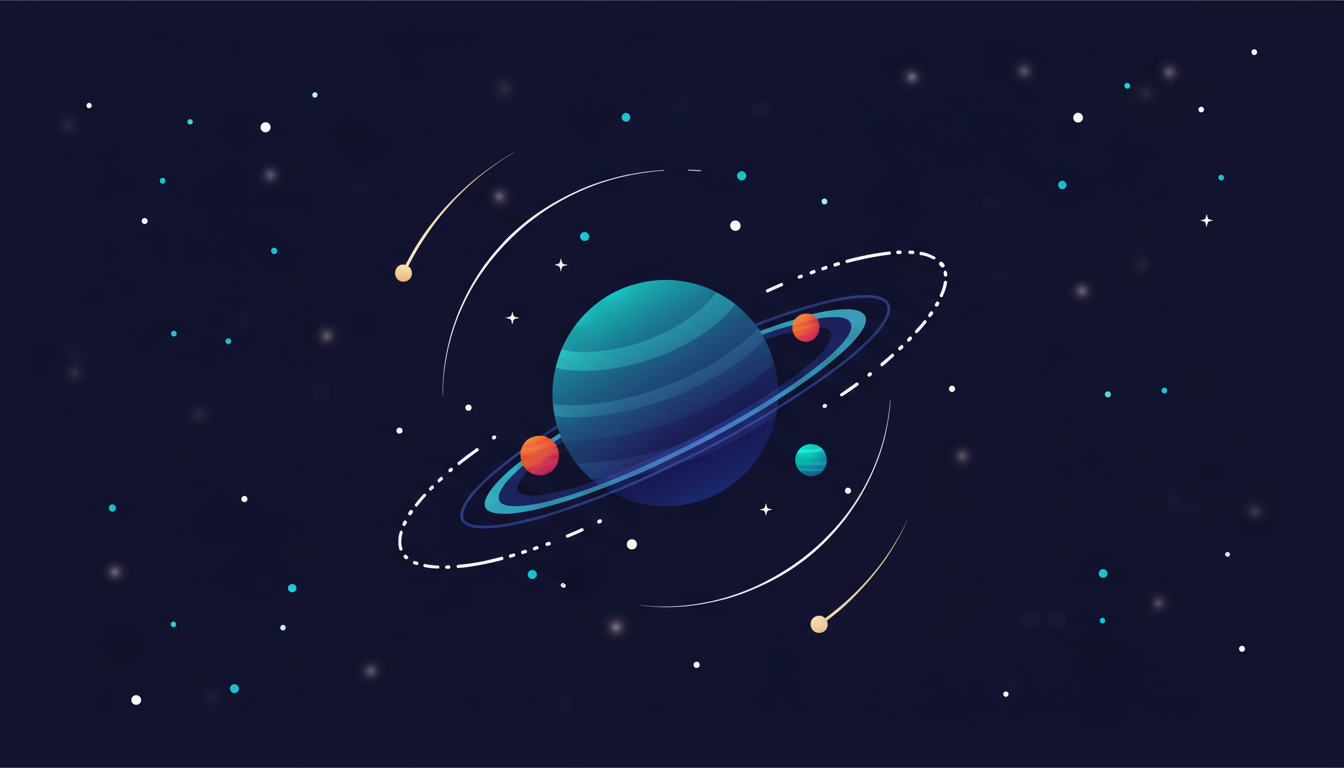
The mathematical term for the shape created by one circle rotating around another is an epitrochoid. Depending on the ratios of speed and distance between the two bodies, an epitrochoid can take many forms. If a moon orbits very fast or is very far from its planet, its path will show clear loops or 'spirals.' Conversely, if the moon orbits slowly or is very close to the planet, the path becomes a simple wobbly circle.
In the case of our Moon, the parameters are quite extreme. The Sun is roughly 400 times further from the Earth than the Moon is, and the Moon completes about 13.5 orbits for every one trip the Earth takes around the Sun. When you plot these numbers, you find that the Earth-Moon system sits in a very specific 'convex' region of the epitrochoid spectrum. This is rare among moons in our solar system and highlights how unique our celestial neighbor really is.
ここからが大事な
ポイントです
具体例・注意点・明日から使えるヒントを整理しています。
✨無料閲覧で全文 + 図解の完全版を3日間いつでも読み返せる
あなたの好きな動画も、
1〜2分でAI要約
📚 お気に入り保存 + ✨ あなたの動画をAI要約
(無料登録10秒)
✏️ この記事で学べること
- ▸、 。 、 、 、 。
10秒で完了・パスワード作成不要